Stage Left, Culture Right: 8 American Rock Festivals That Didn't Just Book Bands — They Built Movements
Stage Left, Culture Right: 8 American Rock Festivals That Didn't Just Book Bands — They Built Movements
There's a version of festival history where everything is passive — crowds show up, bands play, people go home sunburned and satisfied. But that's not the real story. The real story is messier, louder, and a whole lot more interesting. Because sometimes a festival doesn't just reflect what's happening in rock music. It causes it.
From dusty fairgrounds in the Midwest to sun-baked lots in California, certain American rock festivals have functioned less like entertainment events and more like cultural laboratories. The right lineup, the right crowd, the right moment — and suddenly you've got a movement on your hands. Here are eight festivals that didn't just ride the wave. They made it.
1. Lollapalooza (1991) — The Alternative Nation Gets a Capital City
Before Perry Farrell turned Lollapalooza into a traveling circus in the summer of 1991, "alternative rock" was more of a vibe than a genre. It was college radio stuff, indie store cred, something your cool older cousin listened to. Then Jane's Addiction, Nine Inch Nails, Living Colour, and Siouxsie and the Banshees all shared the same bill — and suddenly alternative had an address.
What Lollapalooza did wasn't just aggregate cool bands. It told mainstream America that there was a whole ecosystem outside of hair metal and pop radio, and that ecosystem had teeth. The festival's early years essentially drafted the blueprint for what we now call the alt-rock boom of the '90s. Booking agents and label A&R reps who attended those first tours came away with a completely different sense of what rock audiences were hungry for.
2. Roskilde's American Ripple — And the Midwest's Answer to It
Okay, Roskilde is Danish — but its influence on American festival culture is impossible to ignore. When US promoters in the mid-'90s started paying attention to how European festivals were blending punk, metal, and experimental acts on the same grounds, regional American events started following suit. Festivals like Buzz-Oven in Dallas and the Warped Tour picked up that cross-genre torch and ran with it, creating environments where hardcore kids stood next to indie fans without it feeling weird. That cultural mixing? It's the foundation of post-hardcore.
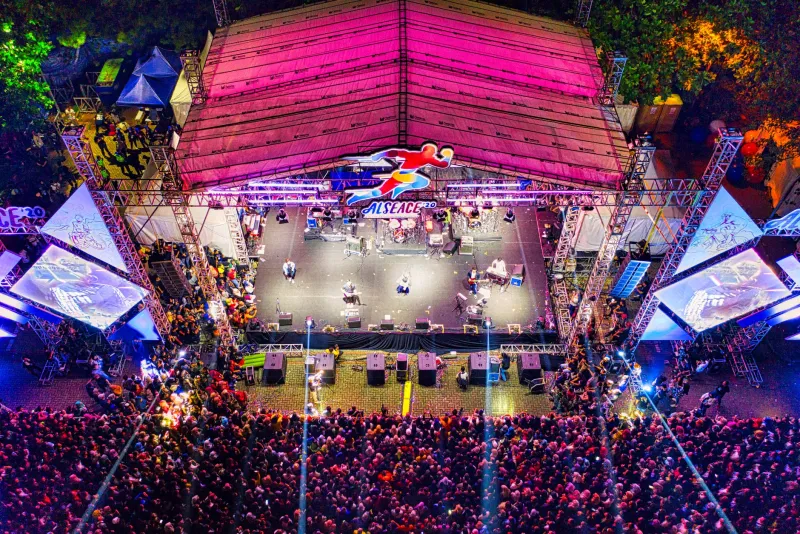
 Photo: The Warped Tour, via www.3bscientific.com
3. The Warped Tour (1995–2018) — A Parking Lot That Raised a Generation
Few festivals have had as direct a hand in shaping a subgenre as the Vans Warped Tour did with pop-punk and its heavier cousins. Running for over two decades across asphalt lots and fairgrounds all over the country, Warped wasn't just a tour — it was a finishing school for bands like Thursday, Underoath, and Paramore. It gave them access to audiences they couldn't have found on their own, and it gave those audiences a sense of belonging that turned casual listeners into lifelong scene participants.
The festival's DIY-adjacent booking philosophy — where smaller acts could buy onto the bill and hustle their way to bigger slots — created a meritocratic ladder that directly shaped the post-hardcore and emo explosions of the early 2000s.
4. Ozzfest (1996) — Heavy Metal Gets Its Own Country
Sharon and Ozzy Osbourne didn't just create a festival when they launched Ozzfest in 1996. They essentially seceded from the mainstream music festival world and built their own nation. At a time when heavy metal was being quietly shuffled to the margins, Ozzfest planted a flag and said: this audience is real, this music matters, and there are more of us than you think.
The ripple effects were enormous. Nu-metal — love it or hate it — owes a significant debt to the platform Ozzfest provided. Bands like Slipknot, System of a Down, and Disturbed got early national exposure through Ozzfest stages, and the festival's consistent championing of heavier sounds helped keep metal commercially viable through a decade that wasn't always kind to it.
5. Coachella's Rock Years (1999–2007) — When the Desert Chose Its Favorites
Before Coachella became synonymous with flower crowns and EDM, it was genuinely one of the most adventurous rock festivals in the country. The early years — particularly the first event in 1999 headlined by Beck and Tool — set a tone of eclectic curation that influenced how rock promoters thought about diversity within a single lineup.
The festival's willingness to pair post-punk revivalists like Interpol and The Strokes with legacy acts helped cement the early 2000s indie rock renaissance as a legitimate cultural moment rather than just a critical darling's footnote. When booking agents saw those crowds losing their minds for bands that hadn't yet broken radio, it changed the calculus for what "mainstream" could mean.
6. Bonnaroo (2002) — Where Jam Met Punk and Nobody Fought About It
Manchester, Tennessee might seem like an unlikely birthplace for a genre collision, but Bonnaroo's early years did something genuinely radical: they convinced jam band fans and indie rock devotees to share a field. That sounds minor until you realize how tribal music scenes were in the early 2000s. These were not groups that typically occupied the same cultural space.
Bonnaroo's cross-pollination approach — booking Widespread Panic alongside Sonic Youth, or Trey Anastasio next to Wilco — created a permission structure for listeners to expand their tastes. Out of that open-mindedness grew a more fluid understanding of what "rock" could encompass, feeding directly into the progressive and psychedelic rock revivals that would follow later in the decade.
7. Download Festival's US Influence — And What It Sparked at Home
Download Festival in the UK has long been the gold standard for hard rock and metal curation, but its influence on American booking philosophy is often underappreciated. US promoters who attended Download in the mid-2000s came back with a clear message: rock audiences will show up in massive numbers if you treat the genre with respect and build a bill that reflects its full range.
That thinking fed directly into the revitalization of American hard rock festivals — events like Rock on the Range (Columbus, Ohio) and Carolina Rebellion, which gave US metal and hard rock fans a domestic answer to what was happening overseas. These festivals didn't just entertain; they validated a community that had started to feel invisible in the broader festival conversation.
8. Rock on the Range (2007) — The Heartland Stakes Its Claim
Launched in Columbus, Ohio, Rock on the Range arrived at a moment when hard rock was being largely ignored by the coastal tastemaker press. And it didn't care. The festival leaned hard into its Midwestern identity, booking acts that mainstream critics had written off — and selling out stadiums doing it.
Over its run, Rock on the Range became one of the most important proving grounds for modern hard rock and metal in America. Bands that graduated from its smaller stages to its main stage saw career trajectories shift dramatically. More importantly, the festival proved that there was a massive, underserved audience for hard rock outside of the coasts — a realization that reshaped how labels and booking agencies thought about regional markets.
The Architect Theory of Festivals
Here's the thing that all eight of these festivals share: they weren't just responding to what audiences wanted. They were making decisions — about lineups, about atmosphere, about which artists deserved a bigger spotlight — that actively shaped what audiences came to want next.
That's the difference between a great festival and a genre-defining one. Anyone can book the hottest acts. The ones that matter are the ones willing to book the next hottest acts before anyone else knows it, and then build a world around them that makes the whole thing feel inevitable in retrospect.
Rock music has always evolved through exactly this kind of cultural pressure — the right stage, the right crowd, the right moment of collective recognition. These eight festivals understood that, even if they didn't always articulate it that way. And the movements they sparked? Still reverberating.