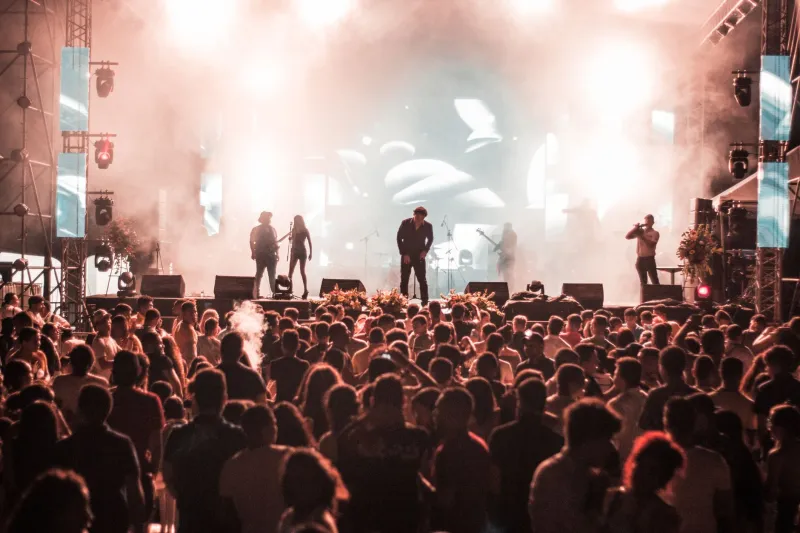
Before and After: What Happens to a Town's Music Scene When a Rock Festival Moves In
Photo: Donald Trung Quoc Don (Chữ Hán: 徵國單) - Wikimedia Commons.(Want to use this image?), CC BY-SA 4.0, via Wikimedia Commons
There's a version of this story that gets told a lot. A mid-size American city — maybe a college town, maybe a post-industrial comeback narrative in progress — lands a major rock festival. Hotels fill up. Restaurants post record weekends. The mayor gives a quote about economic impact. The festival returns the following year, and the year after that, and suddenly the city has an identity it didn't have before.
That version is real. It's also incomplete.
The version that rarely makes the press release involves a dive bar that closed because its landlord tripled the rent after the festival put the neighborhood on the map. Or the local promoter who spent fifteen years building a regional booking network and suddenly found herself competing with festival infrastructure she couldn't match. Or the band that got a shot opening a side stage only to discover that the exposure didn't translate into anything they could actually bank.
Both versions are true. The question is what you do with that.
The First Wave: Energy and Opportunity
When a major festival first arrives in a city, the immediate effect on the local music scene tends to be positive — or at least exciting. Venues book more aggressively in the weeks surrounding the event. Local bands get added to satellite programming and unofficial showcases. Journalists and industry people who wouldn't normally be in the market show up, which creates genuine discovery opportunities.
"The first year was electric," says Marcus Delray, a booking agent based in a mid-size Tennessee city that hosted its first large-scale rock festival about seven years ago. "Suddenly we had A&R people in rooms watching bands I'd been trying to get attention for years. That was real. That mattered."
Several local musicians from that market credit the festival's early years with accelerating their careers in ways that traditional regional touring hadn't. Opening slots on side stages, impromptu sets at nearby venues during festival weekend, even just the social media spillover from a suddenly crowded and content-hungry environment — all of it created momentum.
But momentum, as anyone who's watched a local scene evolve knows, doesn't always flow in the direction you'd expect.
The Second Wave: Pressure and Displacement
About two to three years into a festival's residency in a city, something else tends to happen. Property values in the surrounding neighborhoods start climbing. The venues that hosted those scrappy showcase sets start fielding calls from developers. Rents go up. Some spots close.
In Asheville, North Carolina — a city that has hosted various music-forward events and watched its cultural ecosystem shift dramatically over the past decade — venue owners describe a pattern that feels familiar to anyone who's watched gentrification move through a creative community.
"The festival puts a spotlight on the neighborhood," says one longtime Asheville venue operator who asked to remain unnamed. "And that spotlight attracts money. And money doesn't care about the scene. It cares about square footage and foot traffic."
This isn't unique to Asheville, and it isn't unique to rock festivals. But the scale and speed of a major festival's cultural footprint can accelerate pressures that might otherwise take a decade to materialize.
Local promoters describe a related phenomenon in the booking world: once a city is associated with a major festival, national touring acts start routing through it more aggressively. That's ostensibly a good thing. More shows, more options, more energy. But it also compresses the market in ways that can squeeze out the mid-tier local promoters who kept the scene alive during the lean years.
"I used to be one of maybe three people in this city who could put together a 500-cap rock show," says Delray. "Now there are festival-affiliated promoters here year-round, and they have resources I'll never have. The competition changed."
What the Local Bands Actually Got
The question of whether local artists genuinely benefit from festival proximity is more complicated than the marketing language suggests.
Festival side stages and local showcase slots are real opportunities. But the pipeline from "local opener at the festival-adjacent show" to "working band with a sustainable career" is not automatic, and several musicians interviewed for this piece describe the experience as more visibility than traction.
"I played three festival-weekend shows one year," says a guitarist from a rock band based in a festival host city in the mid-Atlantic. "Instagram went crazy. We got some new followers. And then the festival left town and everything went back to exactly what it was before. The industry people who saw us didn't follow up. The buzz didn't convert."
Others tell a different story. A handful of bands in markets like Knoxville, Richmond, and Lawrence, Kansas have pointed directly to festival adjacency as a turning point — the moment when regional credibility became something more portable. The difference, most agree, tends to come down to timing, genre fit, and whether the band was genuinely ready when the spotlight arrived.
The Long Game: What a Scene Looks Like After a Decade
The most instructive data point isn't what happens during the festival's first few years. It's what the local music ecosystem looks like a decade in.
In cities where festivals have maintained long-term presences, the picture tends to be genuinely mixed. Infrastructure improves — better venues, more sophisticated production resources, a larger pool of experienced local crew. But the character of the scene often shifts. The DIY energy that made the market interesting in the first place gets replaced by something more polished, more commercially oriented, more legible to the national industry.
"It's not that the scene gets worse, exactly," says one regional music journalist who has covered the same mid-size market for fifteen years. "It gets more professional. Which sounds like a good thing. But some of what made it special was the roughness. The weirdness. The fact that you could take a risk here because nobody was really watching. Once people are watching, that changes."
The venues that survive tend to be the ones that figured out how to position themselves within the festival's orbit rather than outside it. The promoters who thrive are often the ones who found ways to partner with or work adjacent to festival infrastructure rather than compete directly with it.
And the bands? The bands keep playing, because that's what bands do. Some of them find that the changed landscape works in their favor. Some of them find that the scene they grew up in has become unrecognizable. Most find something in between.
The Honest Accounting
None of this is an argument against rock festivals or the cities that host them. The cultural and economic contributions are real, and the opportunities they create for artists and industry workers are genuine.
But the full ledger includes more than the ticket sales and the hotel occupancy rates. It includes the bar that couldn't make rent anymore, the booking culture that got crowded out, the band that got a taste of visibility without the follow-through. A scene's health isn't measured only in the moments when the spotlight is brightest. It's measured in what's left when the festival trucks pull out and the city goes back to being itself.
The best outcomes happen when festival organizers treat local music ecosystems as partners rather than backdrops — when the investment in a city's scene is ongoing, intentional, and designed to leave something behind.
The worst outcomes happen when nobody bothers to ask what was already there before the festival arrived.